In December 2022, I gave a presentation to my team at McKinsey called "What is a Disability?" It was not a technical talk. It was about language — about how the words we use to describe disability reveal which mental model we are operating from, often without realizing it.
A year and a half later, I find myself thinking about that presentation constantly as I watch the AI industry build products that will become essential infrastructure for millions of people. The patterns I see — the assumptions baked into interfaces, the afterthought nature of accessibility, the framing of inclusion as a feature rather than an architecture — map almost perfectly onto models of disability that society developed (and in some cases, abandoned) decades ago.
The five models, briefly
There is a rich history behind how we have understood disability as a society. I think of these as lenses — each one focuses on a different part of the picture, and the lens you are looking through determines what you build.
The medical model
Disability is a problem in the person's body that needs to be fixed or managed by medicine.
- handicapped
- suffering from
- special needs
- wheelchair-bound
The interface is designed for ‘normal’ users. Accessibility is a retrofit — a compliance checkbox, not a design principle. Screen readers encounter unlabeled buttons. Streaming text has no live regions. The product works, just not for everyone.
The AI industry is mostly stuck in the medical model
Here is a thought experiment. Open any major AI chat interface in a screen reader. Try to navigate a streaming response. Try to find where new content is appearing. Try to use keyboard navigation to interact with a code block, copy a response, or switch between conversations.
What you will find, in most cases, is an interface designed for sighted mouse users that has been partially retrofitted with ARIA attributes — some correct, some incorrect, many missing entirely. This is the medical model in code: the product was designed for "normal" users, and accessibility is a treatment applied to the symptoms.
When a streaming AI response has no aria-live region, a screen reader user does not know new content has appeared. They are sitting in silence while everyone else watches words flow across the screen. The interface has not just failed to accommodate them — it has excluded them from the core experience of the product.
From accommodations to inclusivity
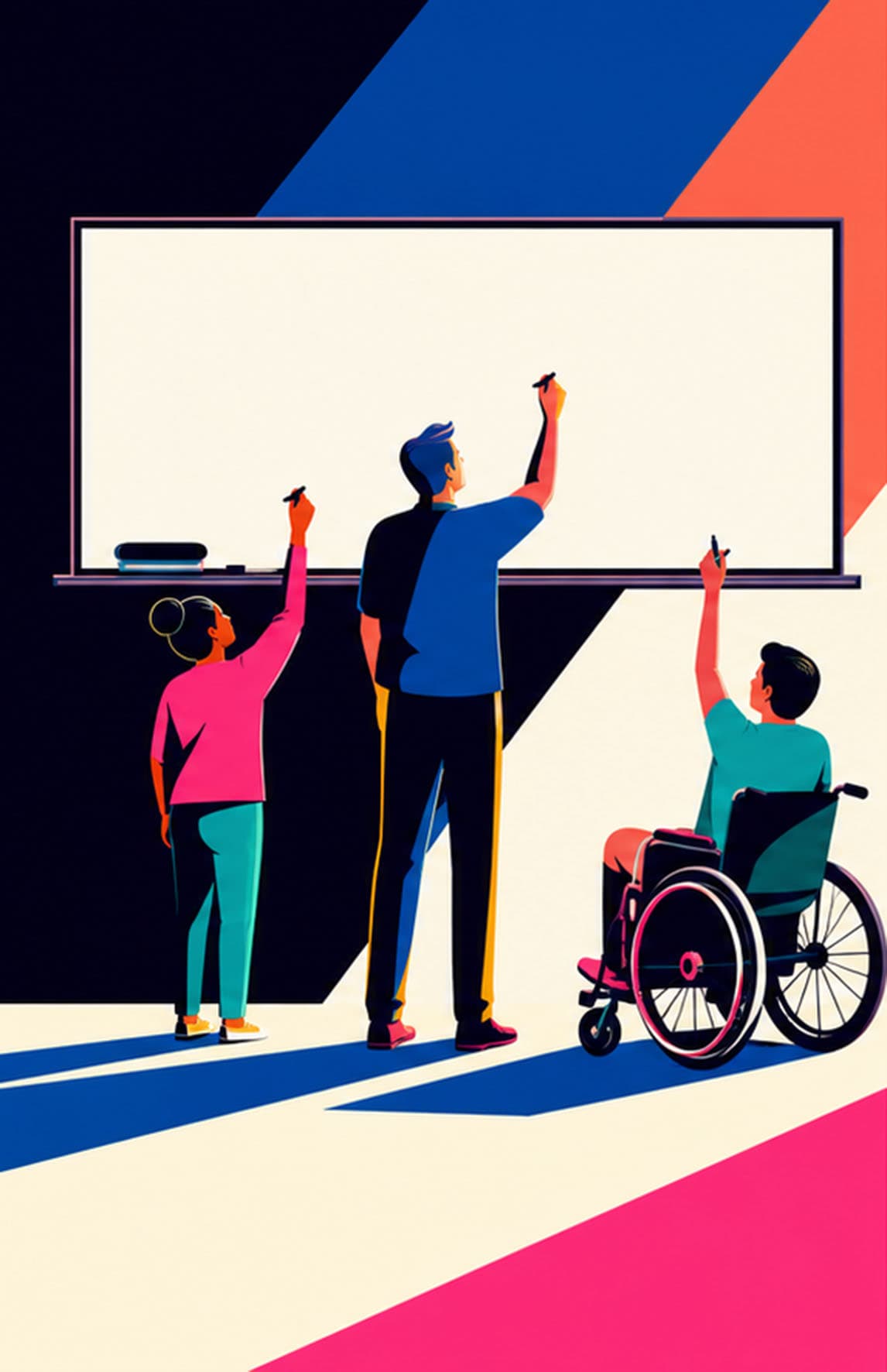
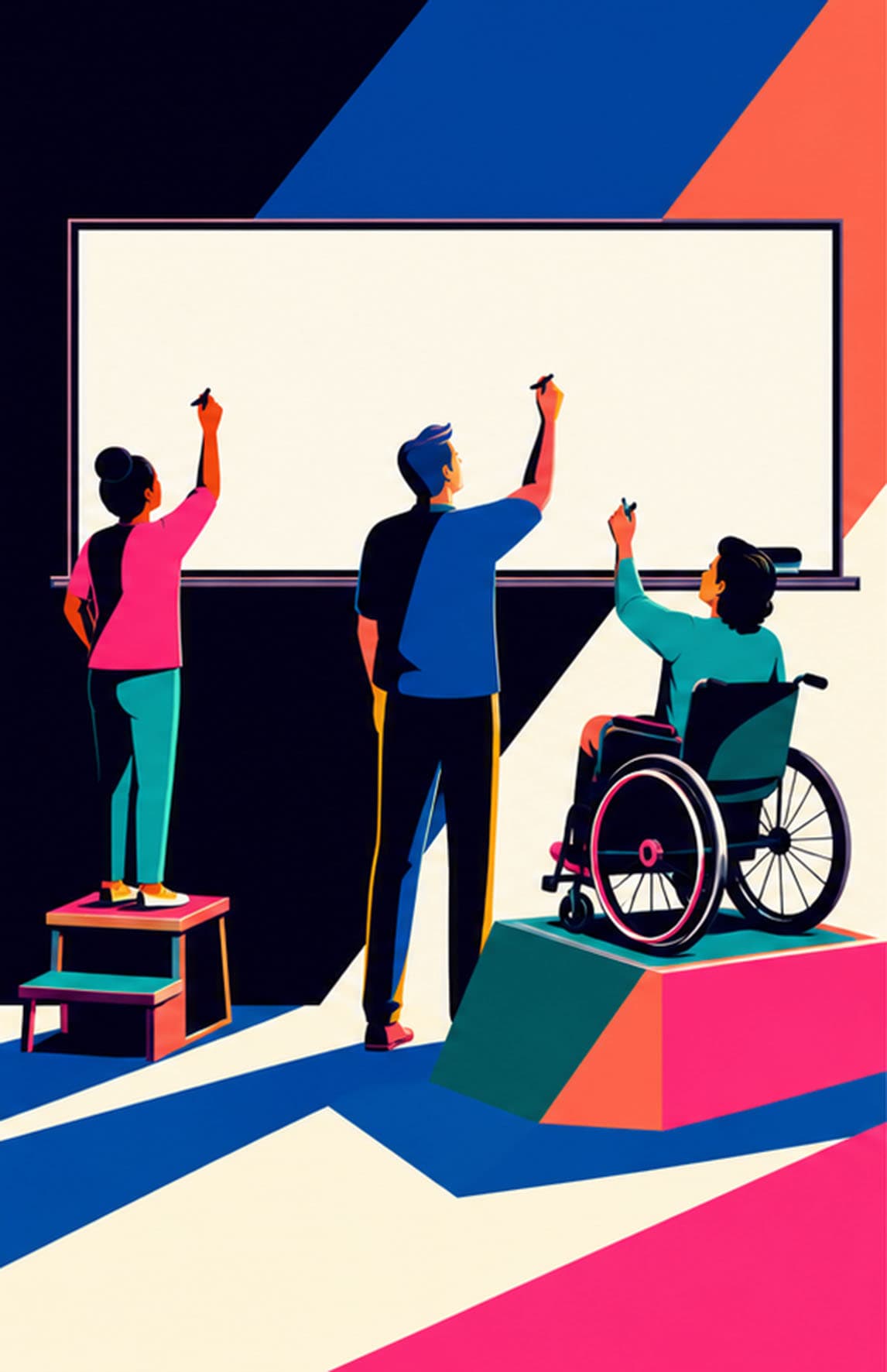
My presentation at McKinsey ended with an illustration that I think about constantly: three panels showing the difference between equality, accommodations, and inclusivity. I've included a revamped version below. It's a great illustration of what kind of products you can build when you consider accessibility at the very beginning, instead of tacking it on at the end.
Equality
Accommodation
Inclusivity
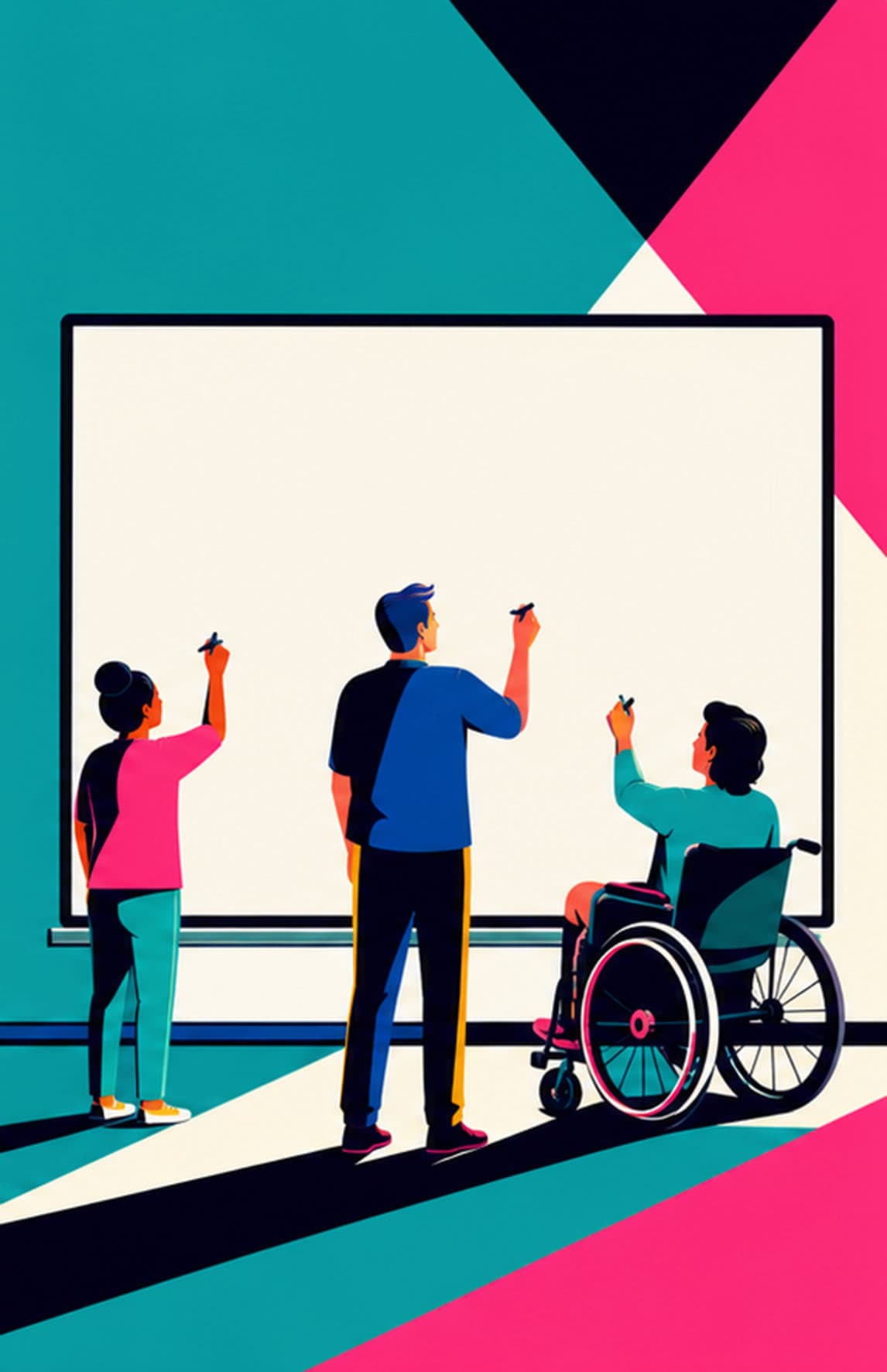
The goal is not to hand out better boxes forever. The goal is to stop designing environments that require boxes in the first place.
For AI interfaces, "equality" looks like shipping the same chat UI to everyone and calling it done. "Accommodations" looks like adding a high-contrast mode or a screen reader toggle. But "inclusivity" looks like something fundamentally different: an architecture where semantic HTML, keyboard navigation, focus management, and live regions are not features — they are the foundation.
Designing for the edges benefits everyone
The most compelling argument for inclusive design is not moral — it is mathematical. This is the insight that changed how I think about my work:
- PermanentLoss of an arm~25K
- TemporaryBroken arm~2M
- SituationalHolding a baby~7–10M
Only about 25,000 people in the US have lost an arm permanently. But roughly 2 million have a temporary arm injury at any given time, and 7–10 million are situationally one-handed — holding a baby, carrying groceries, gripping a subway rail. When Nike designed the FlyEase shoe for people who could not tie laces, they discovered it was also the shoe that parents, elderly people, and busy commuters preferred.
The same scaling effect applies to AI interfaces. A streaming response built with proper aria-live regions does not just help screen reader users — it creates the semantic structure that makes the response parseable, searchable, and navigable for everyone. Keyboard navigation patterns do not just help users with motor impairments — they make power users faster. Reduced-motion preferences do not just prevent seizures — they save battery on mobile.
Good architecture is inclusive architecture. The question is not whether you can afford to build accessibly. It is whether you can afford not to.
AI is the tool that finally makes this possible
If you have worked in software long enough, you have heard some version of this conversation a hundred times: "We know accessibility matters, but we need to ship by Friday." Or: "We will come back and add keyboard navigation in the next sprint." That next sprint never comes. The backlog grows. The inaccessible patterns calcify into inaccessible systems, and eventually the cost of retrofitting exceeds anyone's appetite to approve it.
This is not because engineers are bad people. It is because the economics of building software have always created a false choice between shipping fast and shipping right. Accessibility, performance optimization, semantic HTML, proper focus management — these are the things that get deprioritized when the sprint is tight and the deadline is real. They are treated as the vegetables on the plate: everyone agrees they are good for you, but they get eaten last, if at all.
Here is what I find genuinely exciting: AI coding assistants dissolve that false choice.
Think about what this means in practice. An engineer using an AI coding assistant does not have to choose between building the feature and building it accessibly. They can do both in the same amount of time it used to take to do one. The productivity gain does not just mean shipping faster — it means shipping more completely. It means the things that always got cut for time — the aria-live regions, the reduced-motion media queries, the skip navigation links, the focus-visible states — finally get built. Not because the priority changed, but because the constraint that kept them out of the build disappeared.
For the first time in the history of software engineering, we have a tool that can make inclusive development the path of least resistance rather than the path of most resistance. Companies have been doing the bare minimum for years — not out of malice, but because the "lower priority" work never got enough time, enough people, enough attention. AI changes that equation fundamentally.
But — and this is the part that keeps me up at night — this only works if the AI tools themselves are built with the justice model in mind. If a coding assistant generates inaccessible components by default, it does not just fail to help — it scales inaccessibility at the speed of autocomplete. The patterns it reinforces become the patterns the industry adopts. The tool shapes the craft.
The companies building AI have a choice: they can build tools that perpetuate the medical model at machine speed, or they can build tools that make the justice model the default. The stakes have never been higher, and neither has the opportunity.
What the justice model looks like in code
If we take the justice model seriously — disability as a natural part of human diversity, not a problem to be solved — it changes how we architect AI interfaces at every level.
Streaming responses are built with semantic containers and live regions from the first commit, not added after a compliance audit. Component libraries include focus management, keyboard interaction, and screen reader announcements as required props, not optional ones. Performance budgets are set based on the slowest common device and connection, because that is someone's actual experience of your product. And design reviews include screen reader walkthroughs alongside visual review — not as a separate accessibility pass, but as part of what "done" means.
This is not idealism. It is engineering discipline. And it is the approach I believe AI products — especially those that aspire to be beneficial infrastructure for all of humanity — must adopt. The irony is almost too perfect: the AI tools we build today will determine whether the next generation of software is more inclusive or less. We get to decide which direction the flywheel spins.
This essay is adapted from a presentation I gave at McKinsey in December 2022. The original talk covered the five models of disability and their implications for how we build products. I have extended the argument here to explore what these models mean for AI interfaces specifically.